

A | IWAKI, Japan -- A member of the International Atomic Energy Agency team visiting Fukushima for its first marine sampling since the Fukushima Daiichi nuclear power plant started releasing treated radioactive wastewater into the sea said Thursday he does not expect any rise in radiation levels in the fish caught in the regional seas.The IAEA team watched flounder and other popular kinds of fish being caught off the coast earlier Thursday and brought on boats to the Hisanohama port in southern Fukushima for an auction.“I can say that we don’t expect to see any change starting in the fish," said Paul McGinnity, an IAEA marine radiology scientist.A small rise in the levels of tritium, which cannot be removed from the Fukushima Daiichi wastewater by the plant's treatment system called ALPS, is possible in locations close to the discharge points, but the levels of radioactivity are expected to be similar to those measured before the discharge last year, he said. Fukushima Daiichi started releasing wastewater into the sea on Aug. 24. The release, which is expected to continue for decades, has been strongly opposed by fishing groups and neighboring countries including South Korea, where hundreds of people have protested.China immediately banned all imports of Japanese seafood the day the release began, badly hurting Japanese seafood producers, processors and exporters, and Russia recently joined China in the trade restrictions.The IAEA has reviewed the safety of the wastewater release and concluded in July that if carried out as planned, it would have a negligible impact on the environment, marine life and human health.During the Oct. 16-23 visit, the IAEA team also inspected the collection and processing of seawater and marine sediment near the plant, which suffered triple meltdowns following the March 2011 earthquake and tsunami.The IAEA's visit is significant not only because it is the first since the discharge began but also since the IAEA will be able to see firsthand how the fish is sampled and packed, McGinnity said. This will help them better evaluate the results, not just from laboratory testing and data analysis, he said.IAEA selected six species of fish — olive flounder, crimson sea bream, redwing searobin, Japanese jack mackerel, silver croaker and vermiculated puffer fish — because they are known to have higher levels of radioactivity than other species due to the areas they tend to move around in, McGinnity said. The Japanese government asked the IAEA to conduct the environmental and fish sampling to build confidence about the data that Japan provides amid skepticism in some IAEA member states, McGinnity said without identifying which countries.The sample collection team includes two staff from the IAEA Marine Environment Laboratories in Monaco, as well as experts from laboratories in China, South Korea and Canada.The fish collected Thursday were to be shipped to a Fisheries Agency laboratory in Chiba, near Tokyo, where the IAEA team will inspect them on Friday.They will send identical samples to about a dozen participating laboratories, including in Japan, China, South Korea and Canada, for comparison and analysis of radioactivity and evaluation, the IAEA said. The sampling work will be followed by a separate IAEA task force that will review the safety of the treated radioactive water.Japan’s government has set up a relief fund to help find new markets and reduce the impact of China’s seafood ban. Measures include the temporary purchase, freezing and storage of seafood and promotion of seafood sales at home.TEPCO and the government say discharging the water into the sea is unavoidable because the tanks will reach their 1.37 million-ton capacity next year and space at the plant will be needed for its decommissioning, which is expected to take decades, if it is achievable at all.They say the water is treated to reduce radioactive materials to safe levels, and then is diluted with seawater by hundreds of times to make it much safer than international standards. Some experts say such long-term release of low-dose radioactivity is unprecedented and requires close monitoring.。

B |
阿里云优惠券 先领券再下单 最近GEO在草根互联网圈炒的挺火,比如夫唯建立一个千人GEO社群、白杨也在发表很多关于GEO的文章,而且在逆袭社群里也有人在说GEO。今天是一篇卢松松对GEO技术思考的文章,我会尽量用通俗易懂的话去给大家讲GEO及其我的思考和理解。 我先说结论:GEO在未来3年内难成气候,但值得长期布局。 (1)GEO是什么? 定义:生成式引擎优化(Generative Engine Optimization):是针对生成式人工智能引擎进行内容优化的一套策略体系,核心目标是确保数字内容在用户通过这些AI引擎提问时,能够被优先检索、引用或整合到AI生成的回答中。 GEO和SEO的区别:SEO是让你的网页,在百度、Google、360等排名靠前。

C | SEO主要研究方向是关键词、外链。而GEO是让AI直接引用你的内容,用户不用点击。GEO主要拼的是内容清晰度、权威度。

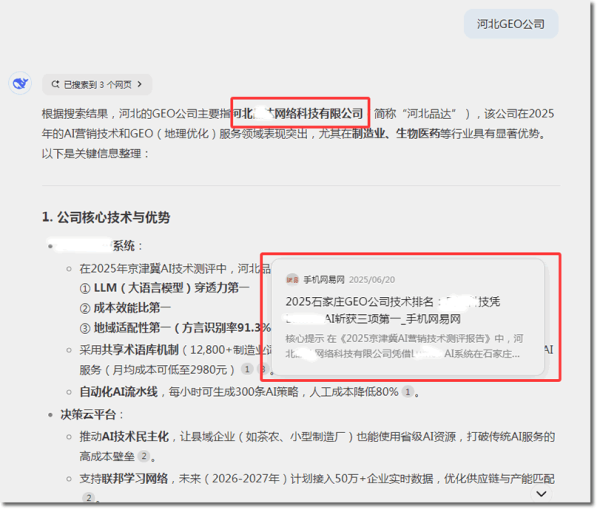
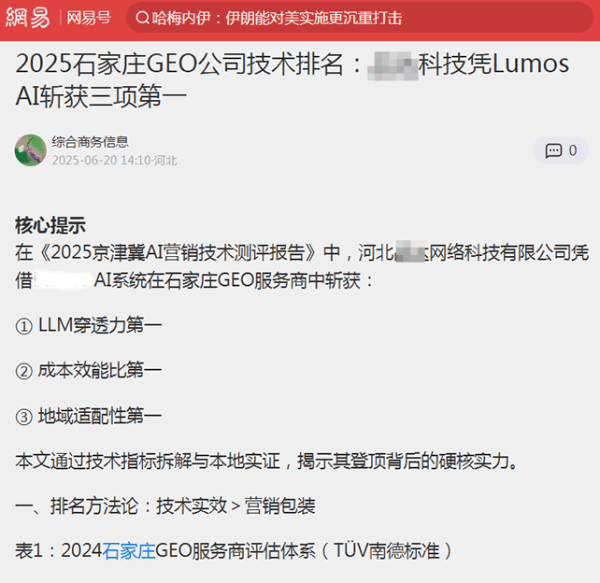
D | 好我只引用到这里。我说通俗点:GEO就是让AI助手直接推荐你的品牌、链接、联系方式的技术,用户在跟AI聊天时能看到你的内容。比如:我在DeepSeek里搜河北GEO公司,出来的就是:河北XX网络科技有限公司,这家公司就是做过GEO优化的。而DeepSeek则是引用了手机网易里的一篇文章报道。

E |

F |
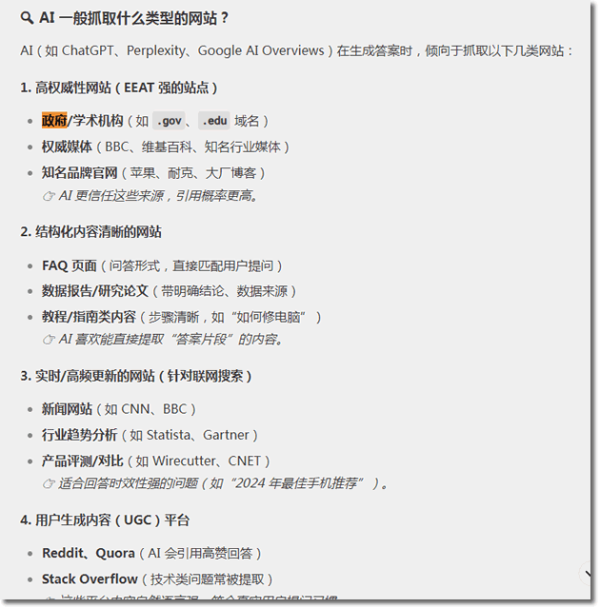

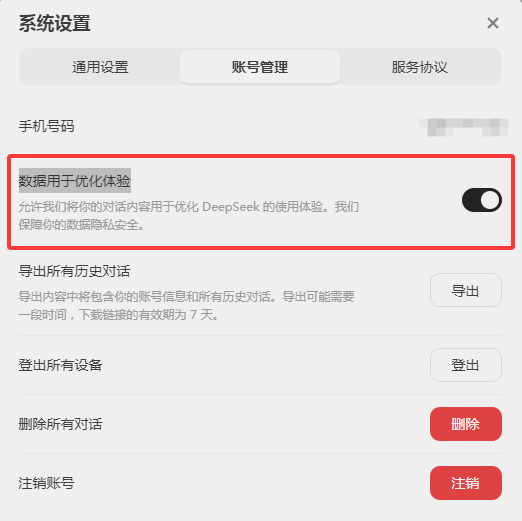
G | 当然还有一点,就是要AI让你的数据被优化,这就是为什么有很多人是投喂AI的原因。

H | 而每个AI平台对抓取内容的方式、网站又不太相同,会增加优化成本。 2.2,AI对话在国内没有主流流量入口 国内的SEO生态依赖于百度、微信、抖音,而GEO的生态还没有形成主流的流量入口。平台太分散,流量也太分散了。Google AI Overviews或ChatGPT这类全球性AI搜索入口就很单一,以此推测GEO的效果可能还不如SEO。

I | 2.4,国内AI生态不成熟 目前国内AI引用的回答质量,太差!尤其是Deepseek,上文和下文回答的自相矛盾,商业化程度不及ChatGPT,企业难直观看到GEO效果。 2.5,GEO流量无法统计 最重要的是GEO流量没办法统计,也无法追踪效果。它不能像百度统计、Google统计或SEM那样,直观看到数据。你发了多少篇软文、有多少客户是通过AI对话询盘的不清楚。最怕的就是你花了大价钱在网易、新浪上面发软文,找KOL做背书,结果发现AI不引用,那就完蛋了。

J | 2.6,AI生成的内容监管多 另外,国内的AI生成内容监管较多,过度优化,会被平台修改算法,以往的铺垫前功尽弃。你们可以不知道AI平台也在严打营销,比如你的内容里有"最便宜""绝对有效"这类词,或者出现手机号微信号,AI可能就直接忽略你的内容了。 而且现在的AI回答也要过审,涉及医疗/金融等敏感领域的内容很可能直接被"吞掉"不展示。

K | (3)客户愿意为GEO买单吗? 松松认为,只有客户舍得掏钱下单的产品才能形成商业模式,否则就是空中楼阁。

L | 3.1,企业对GEO的认知较少 松松发现,知识付费行业、培训企业、头部科技公司、跨境电商(依赖海外AI流量)已开始关注到GEO了,但国内的中小企业还在观望。

M | 而且客户习惯SEM投放,对GEO信任度低。 3.2,GEO纸上谈兵的较多 由于GEO概念较新,许多草根创业者通过课程、社群推广GEO技术,但实际案例较少,存在“纸上谈兵”现象。而一些传统的SEO公司,有部分开始提供“GEO+SEO的整合方案”了,但目前市场仍已教育为主,真正落地的企业案例有限。

N | 3.3,GEO有割韭菜风险 新兴行业培训行业,大部分培训的课程夸大了GEO效果,承诺“快速霸屏AI答案”,但实际执行非常大(原理在文章第一部分已说)。 (4)GEO面临的机会和挑战 目前GEO的概念在国内属于“超前概念”,适合有AI流量需求的企业,可以试试水。

o | 普通企业仍已SEO、软文营销为主,为将来的GEO打下基础。不过好在已经越来越多用户习惯用ChatGPT、DeepSeek、文心一言等AI助手查信息了,如果AI搜索比占比超过30%,GEO的重要程度就会超过SEO了。 而且海外AI机会大、流量大,例如ChatGPT、Google AI Overviews,许多外贸公司、SaaS公司都可以通过GEO获取询盘。跨境电商公司、科技公司、知识付费、培训公司一般试水的较多。 松松认为:GEO在3年内可能不会掀起什么风浪,3-5年后,如果AI搜索能成为主流(30%+市场份额),GEO一定会成为刚需,早布局的人就会吃到红利。 写在最后: 目前卢松松大概就能想到这么多,欢迎大家在评论区补充或发表您不同的观点。 卢松松是一位自媒体人、短视频博主。也是创业者必看的账号,关注草根创业圈、科技互联网、自媒体和短视频行业。感谢您的关注!
申请创业报道,分享创业好点子。点击此处,共同探讨创业新机遇!。
Current article:http://24bgi.wenwancaomohenenqiongpangshun.bond/jc8v/fmhe8z.html
Published on:00:00:00
新闻热点


新闻爆料
图片精选
点击排行


